.png)
How the Game Industry Works: a Complete Guide from Brazilian Games Studios

Hello! In 17 years making games in Brazil, I have lost count of how many times I had to explain how this industry works. I have explained it to accountants, lawyers, government officials, investors, teachers, and to parents and grandparents worried about the kid glued to a tablet. Lately, I have also explained it to international publishers and service buyers looking at Brazil for the first time.
Every conversation had a different angle, but almost all of them started from the same place: very few people outside the industry know how a game becomes a business.
After repeating that conversation so many times, I decided to write the full version once and for all. This is that post. We are talking about a global market bigger than the film and music industries combined, in which Brazil is a giant as a consumer and still has an ocean of room as a producer.
I will show you how a game is made, where the money flows, what the law already covers, and why this is a unique moment for anyone who wants to build, invest or partner around games in Brazil. I write as president of ASCJogos, the game development association of the state of Santa Catarina, and as a studio co-founder, so expect official data mixed with the experience of someone who has walked most of these paths.
And there is a number midway through this text that surprises even industry veterans.
This guide is long on purpose. Use the table of contents to jump straight to what interests you, or read it in order: the story tells itself.
In this guide:
What are the stages of making a game
Here is the first thing almost nobody outside the industry imagines: a commercial game consumes from six months to three years of a full team's work before it earns its first cent. It is not an app you publish in an afternoon. It is a product that is born, grows and matures before it meets its audience.
I will simplify the path considerably, and I want to be explicit that it is a simplification.
Every game is its own case: a game jam project is born in a weekend, lean teams have shipped commercial hits in six months, and a AAA title can take seven years with hundreds of people. The durations below are typical of a mid-sized indie game; smaller projects compress everything.
Idea and prototype (weeks to 3 months). Everything starts with an idea and a rough prototype built to answer one question: is this fun? Most ideas are discarded at this stage, for a simple economic reason: killing a bad project on paper costs a weekend; killing the same project after a year of production costs the studio's budget. Knowing when to push forward and when to stop is one of the most important (and hardest) decisions in game development, and it deserves a full post of its own, which I still owe you.
Funding (months to years). It almost always happens in parallel with everything else. Pitching to publishers, applying to grants, chasing investment, or simply the founder's own pocket. In Brazil, this stage often takes longer than the entire pre-production.
Pre-production (3 to 6 months). Defining scope, technology, art direction and the production plan. It is the cheapest stage to make mistakes in, and the most expensive one to skip.
Production (6 months to 3 years). The mountain in the middle. This is where most of the cost and most of the team live: programming, art, design, audio, narrative. Salaries go out every month. No revenue comes in.
Localization and polish (3 to 6 months, overlapping production). Translating and adapting the game into five, ten or more languages, testing exhaustively, fixing bugs, optimizing performance. Heavy work that players only notice when it is missing.
Certification and launch (weeks to months). On consoles, the game goes through formal approval. Yes, Nintendo, Sony and Microsoft evaluate and certify every title before it reaches the store. On PC and mobile the process is lighter, but it exists.
Post-launch (3 to 6 months). Fixes, balance adjustments and improvements responding to what real players did with the game. The work does not end at the premiere.
Live services (years, when applicable). For live-service games, launch is the beginning, not the end: new content, events, seasons and continuous maintenance for years.
Marketing (transversal). It is not a stage, it is a ribbon running under all the others. It starts 12 to 18 months before launch, with wishlists, trailers and festivals. By the time that trailer finally reaches you, the game had probably been promoted for over a year.
If you had never seen this map, keep the general picture: months or years of effort by a multidisciplinary team, with the first cent of revenue arriving only at the very end.
And it is precisely that detail about the first cent that defines the entire economy of the sector. Let's follow the money.

How a game makes money
Cash flow: premium, free-to-play and work for hire
Here is the second thing that surprises newcomers: most games released in the world never recover what they cost. The sector sustains itself on the few that recover their investment many times over. It is a portfolio business built on calculated bets, not guaranteed income.
That happens because a studio's cash flow is unusual. Months or years of pure cost, with salaries going out every month and nothing coming in, followed by an almost binary event called launch. What the revenue looks like after that depends on the business model.
In the premium model, the game is sold for a fixed price, as is common on PC and consoles. A large share of the product's lifetime revenue tends to arrive in the first weeks, followed by a long tail sustained by sales events, editions and store visibility.
In free-to-play, the drawing flips. The game ships for free and revenue comes gradually, from in-game purchases and advertising. The challenge becomes retaining players for months, because each user is expensive to acquire and yields little at a time.
In work for hire, there is no launch and no curve. The studio delivers agreed stages (milestones) and gets paid for them. Cash flow is predictable and calmer, but it ends when the contract ends.
Each model has its own risk and rhythm. That is why so many studios, in Brazil and elsewhere, combine client work that pays the monthly bills with original projects that can become long-term assets.
Keep that split in mind, because it returns later when we open the hood of the business. For now, follow the money: in every one of these models, it passes through a store first. And the store charges a toll.

Where the money flows: the stores and the 30% cut
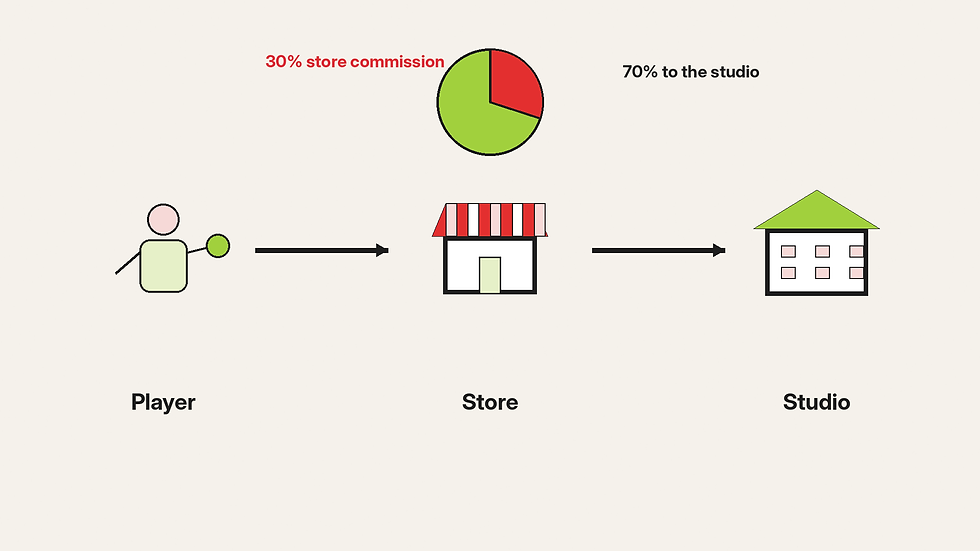
When a player buys a game on Steam, Google Play or the App Store, their contract is with the store, not with the studio. The store processes the payment, collects consumption taxes, delivers the product and passes on to the developer their share. That share, as a rule, is 70%.
The other 30% is the platform's commission, the sector's standard toll. On Steam, for example, that slice drops to 25% once a game passes US$ 10 million in sales, and to 20% above US$ 50 million, which in practice only benefits the biggest titles.
itch.io is more flexible and lets developers set their own split. Consoles have their own rules and tighter gatekeeping: the studio needs to be approved by the manufacturer and to work with devkits, special development hardware units loaned or sold under license.
For lawyers and judges, this chain matters a great deal. The player, store, publisher and studio relationship defines who answers for what in a dispute. Refunds, for instance, are usually store policy, not studio policy. Understanding this structure avoids decisions that address the wrong company.
Keep this map of the money's path, because it returns when we talk about the Brazilian scenario. But first, we need to talk about what the player is actually buying. Because very often it is not quite what they think.
What you actually buy inside a game
Start with a revelation that generates a lot of lawsuits: when you buy an item inside a game, legally you almost never bought anything. You licensed access to an item within a service.
The difference between buying and licensing sits at the center of much of the sector's consumer litigation, and lawyers, judges and consumers alike benefit from knowing the distinction.
There are several monetization models, and each deserves to be known by name:
Premium: you pay once and take the game. The oldest and most direct model.
Free-to-play: the game is free and revenue comes from other sources, described below.
In-app purchases (IAP): they can be consumable (coins, lives, items spent on use) or non-consumable (a character, a level, an expansion that stays yours for as long as the service exists).
Subscription: recurring access while you pay the monthly fee.
Battle pass: rewards unlocked over a season, encouraging the player to come back.
Advertising: the game is free and the bill is paid by advertisers, buying the player's attention.
Microtransactions are already a relevant share of revenue: they represent around 20% of Brazilian studios' income. None of these models is illegal or dishonest by nature; excellent games use every one of them.
The problem appears in the dose and in the audience. And there is one audience where the wrong dose does far more damage.

Games and children: if it's free, who is paying the bill?
When a game is free, the revenue comes from one of two places: from a minority of players who buy items, through systems designed to maximize that spending, or from advertisers paying for the user's attention. Neither is illegal. But both demand extra care when the audience includes children, especially under 10.
And here is a warning I consider more important than the age rating itself: the rating label mostly evaluates content (violence, language, themes), but the most frequent risk for children lives in the monetization model.
A game that looks entirely childlike, colorful and without a drop of violence can be aggressive in purchases and advertising. Platforms immensely popular with children, such as Roblox, combine their own virtual currency, frequent purchases and user-generated content, a combination that calls for active attention from caregivers and careful configuration of the parental controls the platform itself offers.
Science has already mapped part of this terrain. Studies link loot boxes, the randomized reward crates, to gambling-like behavior: the research by Zendle and Cairns, 2018, with a large sample, found a correlation between loot box spending and problem gambling.
Not by coincidence, with Brazil's new Digital ECA child protection law in force, games identified as containing loot boxes now receive an automatic 18+ rating in Brazil. That is why some games that looked harmless woke up rated for adults only in Brazilian stores: not because of content, but because of the monetization mechanic. If you publish games in Brazil, this is worth knowing before your next release.
Advertising deserves the same scrutiny. The American Academy of Pediatrics (AAP), in a 2020 policy statement, notes that children up to age 7 have a limited capacity to understand the persuasive intent of an ad, that is, to perceive that someone is trying to change their behavior, and goes as far as recommending a ban on advertising directed at that age group. Surveys cited in US public hearings go further: more than 75% of children between 8 and 11 cannot distinguish advertising from other content.
As co-founder of Truth and Tales, a social-emotional learning platform for children, this topic has followed me for years, and the message I give families is direct: free does not exist. What exists is a business model you have not identified yet. When the product is free, the product is often you, or, in the case of children, your child's attention.
The good news is that there is a serious industry doing it differently, including in Brazil: it is entirely possible to make a good, fun, sustainable game without treating the player as a wallet to be emptied.
Now that you know how the money comes in, let's open the hood of the company that makes the game. Because behind every title there is a business, and it has rules of its own.
How the games business works
Who makes a game and the two business models
Making games is not just programming. A single title brings together programming, art, design, audio, narrative, quality assurance, production, marketing, business development, legal and accounting. It is one of the most multidisciplinary forms of entertainment in existence, and for that very reason one of the hardest to coordinate.
All of those people can work under two business models, and understanding this split is the key to understanding the sector.
On one side are original IP studios, which create, publish and exploit their own games. They take the high risk (they can spend years and not sell) in exchange for the high upside (a hit earns for a long time and builds equity).
On the other side are service studios, which sell hours and deliverables to third parties: co-development, porting (bringing a game from one platform to another), art, audio, QA. Revenue is more predictable and margins tend to be thinner.
In Brazil, the two models coexist, often inside the same company. Abragames research shows that 93% of Brazilian studios have developed original IP and a large share also provides services to third parties. It mirrors the logic that already exists in the software market, separating product companies from custom development.
This is not an academic detail: the distinction has tax, contractual and statistical consequences. And services are not a plan B. Brazilian studios are sought out by major international producers precisely for their technical quality, as our blog post Why do AAA studios hire Brazilian game outsourcing studios? explains. If you run external development for a publisher or a AAA production and have never scouted Brazil, you are overlooking one of the deepest talent pools in the Americas, in a time zone one to four hours from New York.
In both models, though, the long-term value lives in a single asset, one that almost never shows up on the studio's balance sheet and is worth more than any computer or devkit the company owns.

Intellectual property: the asset that sustains the business
That invisible asset is intellectual property. Brand, code, art, music, characters, narrative universe. It is the economic center of a game studio, and understanding that changes how the sector should be evaluated.
Studios that make original IP build equity: every released game is an asset that keeps earning and can be sold, licensed or turned into a franchise. Service studios, by contrast, usually assign the rights of the deliverable to the client and keep the reputation and the portfolio.
That is why contracts matter so much. A well-written work-for-hire contract defines precisely what is assigned and what stays with the studio; a badly written one destroys companies, sometimes years later, when the value of that asset becomes clear.
Publishers and investors know this and evaluate the IP before any spreadsheet. The international market has already noticed what Brazil has: in 2023, Epic Games, maker of Fortnite, acquired the Brazilian studio Aquiris, which became the company's Latin America operation. Nobody buys a studio for its furniture. You buy it for the team and the intellectual property.
A direct note to the legal community: court decisions about game IP do not affect only the case at hand. They affect the valuation of entire companies and the confidence of everyone investing in the sector. It is a technical field that deserves well-prepared professionals, and the series this post opens is meant to help with that.
And if IP is the central asset, the next question is natural: what does Brazilian law say about all this? More than you might imagine, and almost all of it is recent.

What Brazilian law already covers: the Legal Framework, the Digital ECA and the new platform rules
In 2024, the sector gained something it had never had: its own legal recognition. The Legal Framework for Games (Law 14.852/2024) defined what an electronic game is in Brazil and opened the way for more serious public support policies. It was a watershed for an industry that bureaucracy had treated as a hobby for decades.
At the state level, Santa Catarina turned its SC Games program into law, with State Law 19.789/2026, giving local support stability and continuity. And in child and adolescent protection, the Digital ECA (Law 15.211/2025) changed the rules for any game directed at, or likely to be accessed by, minors, including the automatic 18+ rating for games with loot boxes I mentioned in the monetization section.
The platforms moved too, and fast. Since February 24, 2026, Apple blocks the download of 18+ rated apps in Brazil unless the user's age is confirmed, and its Declared Age Range API lets an app receive the user's age range without accessing their birth date. Google launched its Play Age Signals API with a similar purpose.
If you publish or plan to publish in Brazil, treat this section as practical intelligence: rating rules, loot box classification and age gating are now part of your release checklist here. And for anyone making responsible games, clear regulation is not a threat, it is a competitive advantage. It levels the field and rewards those who were already doing the right thing.

With the rules on the table, one business question remains: how big is the Brazilian opportunity, exactly? Time for the number I promised in the introduction.
Brazil on the global board
Brazilian games in numbers: a giant consumer, a rising producer
The global games market should move around US$ 188.8 billion in 2025, according to Newzoo, the sector's global reference in market research. That is the size of the comparison I made in the introduction: more than film and recorded music combined. Digital games stopped being a niche a long time ago.
And Brazil? We are giants as consumers. According to Abragames, the Brazilian game developers association, the country is the tenth largest market in the world and the leader in Latin America, with more than 100 million players. Brazilians spend around R$ 13 billion a year on games (roughly US$ 2.4 billion). According to the Pesquisa Game Brasil survey, almost three in four Brazilians play games of some kind.
Now, the number I promised. The industry that actually develops brazilian games earns around R$ 1.2 billion a year. Put the two figures side by side: of every R$ 10 Brazilians spend on games, less than R$ 1 stays with local developers. Most of it goes to companies abroad.
Read that number as an investor, not as a fan: it is the measure of the available space. Abragames data shows a sector that matured fast: the number of studios jumped from around 200 in 2014 to more than a thousand in 2023, growth of over 400%, employing more than 13 thousand professionals today.
And the export vocation is already real: 58% of Brazilian developers make international sales and 9% already have offices abroad. For international publishers and service buyers, this gap is not a weakness to pity. It is capacity waiting for demand, in one of the few large markets in the world with this much open ground.

To understand why this space exists right now, we need to look at the moment the global industry is going through.
A global industry reshaping (and the window opening in Brazil)
The global games industry is going through its biggest reorganization in decades. Generative AI is touching everything at once: business, planning, development, art, audio, marketing.
In the traditional hubs (United States, Europe, Asia), that movement adds to development costs that keep rising, a market saturated with releases, and successive rounds of layoffs, with tens of thousands of positions cut since 2023 according to independent industry trackers. Part of those decisions is attributed by the companies themselves to the pursuit of efficiency with AI; part is the correction of over-accelerated pandemic growth.
I mention this scenario out of honesty with the reader, not alarm, and for a reason that matters enormously if you are reading this as an international partner: Brazil sits in a different position on the board. While the traditional hubs reorganize, Brazil is a rising market, with billions in consumer spending, more than 100 million players and local production still serving a small fraction of that demand.
In other words: under-explored space. Any company, local or foreign, that positions itself here and finds its audience is looking at one of the rare large markets in the world with this much free terrain.
And Brazil arrives at this moment holding two ready assets. The first: high-level service companies already working for international producers and publishers in art, engineering, co-development and porting, in a time zone compatible with North America and at competitive cost. The second: a growing portfolio of quality original games that need one specific push, mainly in marketing, publishing and user acquisition.
That push usually runs into two practical factors: currency conversion costs (media, tools and user acquisition are paid in dollars) and the low local presence of international companies that know the country. A publisher or technology company with an office in Brazil, understanding our laws and how Brazilian culture behaves, finds ready partners here and an entire market to grow with. This is, frankly, the shortest path to the tenth largest market in the world.
Anyone operating from Brazil also needs to know the navigation map, and it has points that deserve planning: the 30% withholding on US-source revenue, because Brazil does not yet have a tax treaty with the United States, on top of Brazilian taxes when the money arrives; everyday tools billed in dollars, with financial transaction tax and exchange-rate swings in the budget; devkit imports, which still lack a suitable customs regime; and access to capital, since most studios are micro and small companies.
None of these points cancels the math of the window; they indicate exactly where partnerships, local presence and well-designed public policy generate the most value. And that is exactly where everyone gets to play a part.

How each player can help the sector grow
We have reached the practical part. If you read this far, you already know how the industry works. What remains is agreeing on what each of us can do to make it grow, because Brazil's potential is large and the ceiling is far away.
Government and public entities. Support with continuity is worth more than one-off events: a program that lasts ten years builds a sector; an event that happens once produces a photo. Cutting the red tape on devkit imports and international remittances would unlock immediate value for studios. Using public procurement for serious games and training would create qualified domestic demand. And giving the sector an adequate economic activity code would make it visible in official statistics, which today it barely is.
Judiciary and legal professionals. The sector needs professionals who understand intellectual property, licensing and the platforms' chain of responsibility. Well-informed decisions protect consumers and preserve the value of companies. This post is a start, and the series will go deeper into each topic.
Investors and publishers. Brazil delivers art, engineering and co-development with recognized quality and competitive cost, with teams in a North America-friendly time zone and working English. Capital has started to notice: Bossa Invest, for example, set up a games committee and has already invested in local studios. For those coming from abroad, local presence is the multiplier: an office in Brazil, with people who understand our laws and our culture, turns a market of 100 million players into familiar terrain.
New entrepreneurs. Incorporate properly, take care of contracts from day one, and validate the game before scaling the investment. The sector's most expensive mistakes are almost all avoidable with planning. Two of our guides are a good starting point: I have a game idea, now what? and How to prepare for the games market.
ASCJogos exists to connect these dots: industry, government, academia and market. Meet our member companies and talk to us.
Where the professionals come from: academia and training
Here is a curiosity almost nobody outside the industry imagines: a large share of the people working with games in Brazil is, to some degree, self-taught. Not for lack of study, but because for a long time there was nowhere to study games directly.
Most professionals graduated in neighboring fields (computer science, design, arts, communication, music) and learned the craft in practice, through game jams, short courses, communities and by joining established companies, where seniority is built project by project.
That has been changing, for the better. Specific academic training exists today. Our partner Univali runs a Game Design degree that has been shaping talent for more than 15 years, one of the most traditional in the state. Beyond undergraduate programs, the ecosystem offers graduate courses, technical schools, bootcamps and a huge amount of non-academic training, from online tracks to in-person workshops. Each path serves a profile, and there is no single route into the industry.
There is also the training that starts early, before college. The SC Games Program, now consolidated by the recently enacted state law in Santa Catarina, prepares young people from school age to enter the games market, building a talent base the sector will harvest in the coming years. It is the kind of public policy that pays off in the medium and long term, exactly the opposite of one-off support.
For international partners, this pipeline matters too: it is the reason the talent pool here keeps deepening year after year, from junior artists to senior engineers. Talent is formed in many ways. What you cannot do is assume it is born ready.
Conclusion
If you made it here, you now hold a map most people have never seen: how a game is made, how much time and effort that consumes, where the money flows, what the law already covers, and why the current moment, with the global industry reorganizing and the Brazilian market on the rise, opens a rare window.
Talent we have in abundance, and the structure around it advances every year. This is the moment for Brazil to consolidate itself as one of the world's great hubs of game production and culture, and Santa Catarina has everything it takes to lead that movement.
A direct word to international publishers, investors and service buyers: if you are looking for co-development, porting, art, audio, QA, original IP to publish, or a partner to enter the Brazilian market, brazilian games studios are ready today, and ASCJogos is the front door to the studios of Santa Catarina. Write to us, browse our member companies, and come see for yourself. The window is open, and the best partnerships are made by whoever arrives first.
This is the first post in a series on how the games industry works. In the next ones, I will break down each of these topics in more depth, from intellectual property to the path of taxes, from storefronts to public support that actually works. If there is an angle you would like to see first, tell me.
Frequently asked questions
What is the digital games industry?
It is the set of companies and professionals that create, produce, publish and provide services for electronic games, on platforms such as PC, console, mobile and web. It ranges from studios making their own games to companies providing art, audio and development services to third parties.
What are the stages of making a game?
Simplified: idea and prototype, funding, pre-production, production, localization and polish, certification and launch, post-launch and, for live-service games, years of continuous content. Marketing runs across every stage. The whole process takes from six months to three years for a typical commercial game.
How big is the games market in Brazil?
Brazilians spend around R$ 13 billion a year on games, and the country is the tenth largest market in the world and the leader in Latin America, with more than 100 million players, according to Abragames. The industry that actually develops games in the country earns around R$ 1.2 billion a year, which shows the size of the growth space for local production.
How does a game studio make money?
It depends on the model. In premium, it sells the game for a fixed price. In free-to-play, it offers the game for free and monetizes through in-game purchases and advertising. In the services model, it gets paid by clients for agreed deliverables. Many studios combine more than one model.
What are virtual goods in a game?
They are items bought inside a game, such as currency, characters, levels or expansions. Legally, in most cases, the player licenses access to those items within a service and does not acquire ownership of them.
Why are some free games not suitable for children?
Because the age rating mostly evaluates content, but the most frequent risk lives in the monetization model: constant purchases, advertising that young children cannot distinguish from content, and mechanics like loot boxes, which in Brazil now trigger an automatic 18+ rating under the Digital ECA. A game with a childlike look can be aggressive in its monetization.
What is Brazil's Legal Framework for Games?
It is Federal Law 14.852/2024, which legally defined what an electronic game is in Brazil and created guidelines for supporting the sector. It was the country's first broad legal recognition of the games industry.
Why partner with brazilian games studios?
Because Brazil combines a consumer market among the ten largest in the world, more than a thousand active studios with internationally recognized quality, competitive costs and a North America-friendly time zone. For international companies, local presence and partnerships with Brazilian studios are the shortest path into this market.
How can I invest in or hire Brazilian game studios?
Brazil has studios recognized for quality in art, engineering and co-development, at competitive cost. ASCJogos connects partners to these studios; the member companies page is a good starting point for anyone looking for development, porting, art, audio or IP partnerships.
About the author
Leonardo Bilck is president of ASCJogos (Santa Catarina's game development association), CTO of Plot Kids and Plot Interactive, and co-founder of Truth and Tales. He has 17 years in the game industry with 20+ published projects. At Gamescom Latam 2026, he moderated the "I have a game idea, what now?" panel and participated in "Diálogo Estratégico Sul" as ASCJogos representative.
Sources and references
References follow a format close to the Brazilian ABNT standard. The list is shared with the PT-BR edition.
Legislation and official documents
BRASIL. Lei nº 14.852, de 3 de maio de 2024 (Legal Framework for Games). Brasília: Presidência da República, 2024. Available at: planalto.gov.br.
BRASIL. Lei nº 15.211, de 17 de setembro de 2025 (Digital ECA). Brasília: Presidência da República, 2025.
SANTA CATARINA. Lei nº 19.789, de 8 de abril de 2026 (SC Games Program). Florianópolis: Governo do Estado de Santa Catarina, 2026.
APPLE INC. Age requirements for apps distributed in Brazil, Australia, Singapore, Utah, and Louisiana. Apple Developer News, 2026. Available at: developer.apple.com.
GOOGLE. Play Age Signals API: overview. Android Developers, 2026. Available at: developer.android.com.
Market research and data
ABRAGAMES; APEXBRASIL. Pesquisa Nacional da Indústria de Games (National Games Industry Survey). São Paulo: Abragames / Brazil Games, 2024. Available at: abragames.org.
DIÁRIO DO COMÉRCIO. Indústria nacional de desenvolvimento de games cresce e alcança faturamento anual de R$ 1,2 bilhão. Diário do Comércio, 27 Jul. 2025. Available at: diariodocomercio.com.br.
NEWZOO. Global Games Market Report 2025. Amsterdam: Newzoo, 2025. Available at: newzoo.com.
VIDEO GAME LAYOFFS. Independent tracker of game industry layoffs. Available at: videogamelayoffs.com.
Scientific studies and public policy documents
ZENDLE, D.; CAIRNS, P. Video game loot boxes are linked to problem gambling: results of a large-scale survey. PLOS ONE, v. 13, n. 11, 2018. Available at: journals.plos.org.
AMERICAN ACADEMY OF PEDIATRICS (AAP). Digital Advertising to Children. Pediatrics, v. 146, n. 1, 2020. Available at: publications.aap.org.
UNITED STATES SENATE. Committee on Commerce, Science, and Transportation. Written testimony on protecting kids online. Washington: U.S. Senate. Available at: commerce.senate.gov.
Platforms
STEAMWORKS (VALVE). Taxes FAQ: withholding on U.S. source income. Steamworks Documentation. Available at: partner.steamgames.com.
Related ASCJogos content
BILCK, Leonardo Guedes. Como se preparar para o mercado de jogos (How to prepare for the games market). ASCJogos Blog, 18 Oct. 2025.
BILCK, Leonardo Guedes. Tenho uma ideia de game, e agora? (I have a game idea, now what?) ASCJogos Blog, 28 Apr. 2026.
BILCK, Leonardo Guedes. ECA Digital e jogos para crianças (Digital ECA and games for children). ASCJogos Blog, 23 Apr. 2026.
BILCK, Leonardo Guedes. SC Games agora é lei (SC Games is now law). ASCJogos Blog, 9 Apr. 2026.
YELLOW PANDA. Why do AAA studios hire Brazilian game outsourcing studios? ASCJogos Blog, 2 Jun. 2026.
ASCJOGOS. What you need to publish your game's Steam page. ASCJogos Blog, 21 Jun. 2026.


Comments